Tuesday, April 04, 2006

Some naturalized annuals

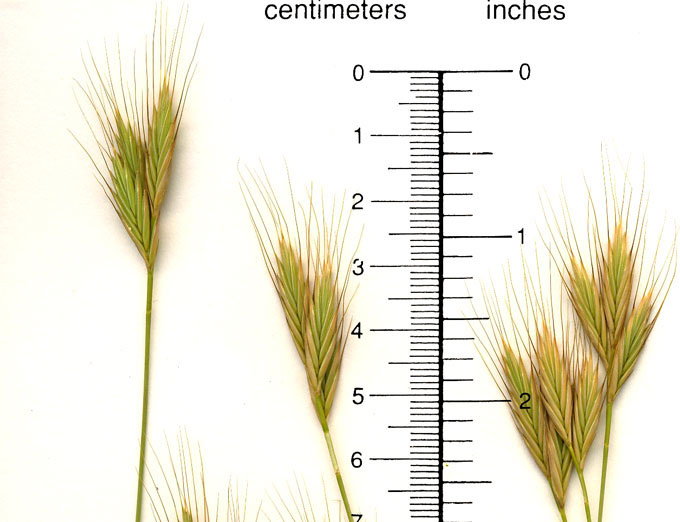
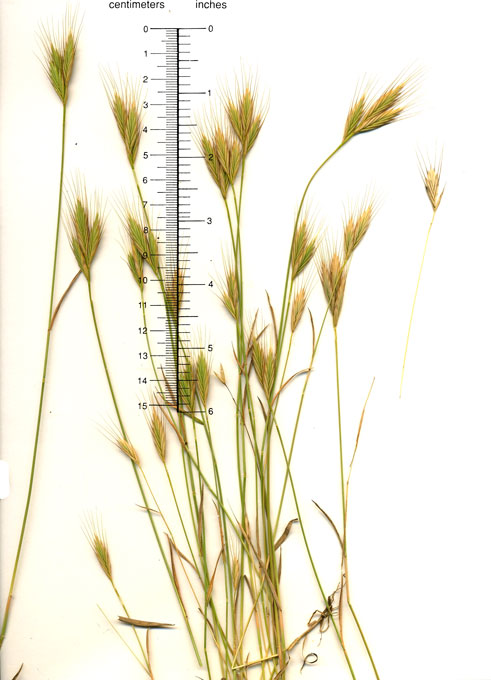
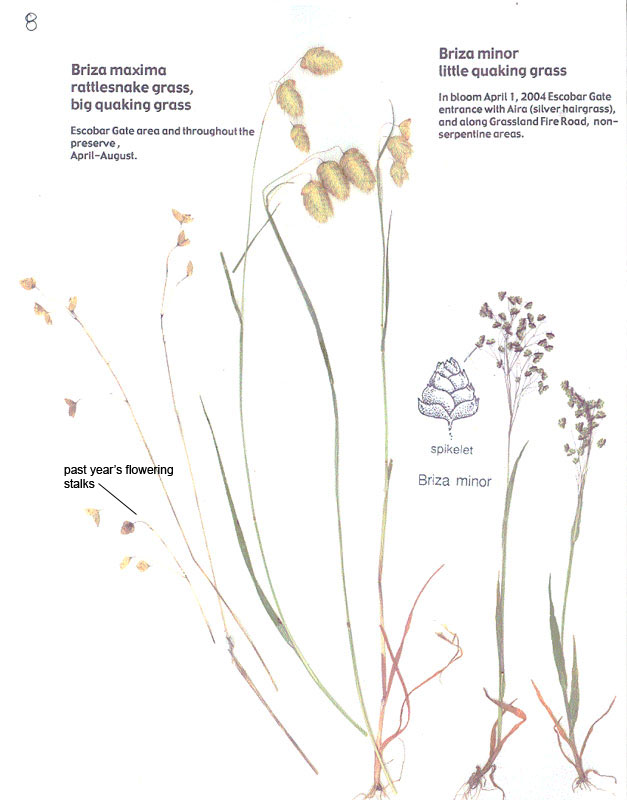
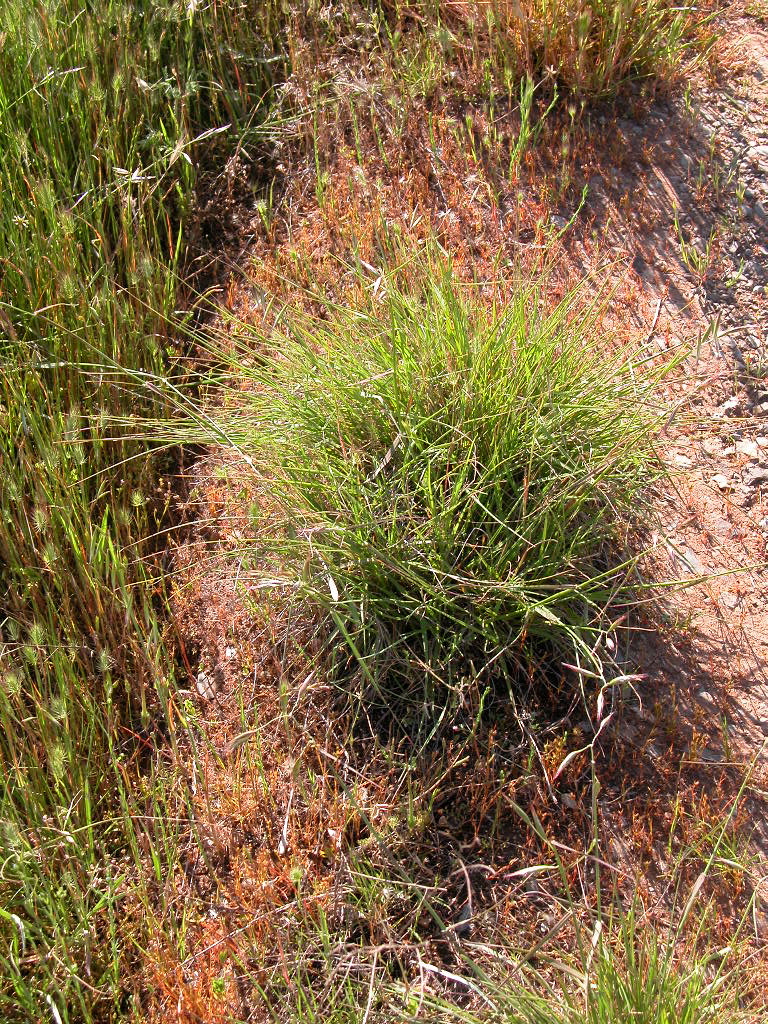
Many of the annual grasses that dominate California valley and foothill grasslands grow in the vicinity of the Preserve's Escobar Gate. At arm’s length, with practice, all should be recognizable to genus and some to species. The underlying rock is sandstone, and the grasses include slender wild oat (Avena barbata), soft chess (Bromus hordeaceus), Spanish brome (B. madritensis ssp. madritensis), ripgut (B. diandrus), farmer’s foxtail (Hordeum murinum var. leporinum), Mediterranean barley (Hordeum marinum ssp. gussoneanum), and rattail (Vulpia myuros) along with brome fescue (V. bromoides). Within a few steps, the diminutive silver hair grass (Aira caryophyllea), dog’s tail grass (Cynosurus echinatus), and little quaking grass (Briza minor) appear. The latter’s larger relative rattlesnake grass (Briza maxima) is also common throughout the Preserve. Further along Road F south of the first serpentine, the widepread weed nit grass (Gastridium ventricosum) debuts. See the posting Replacement of the Native Vegetation and wild oat.

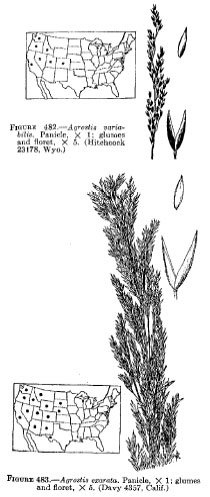
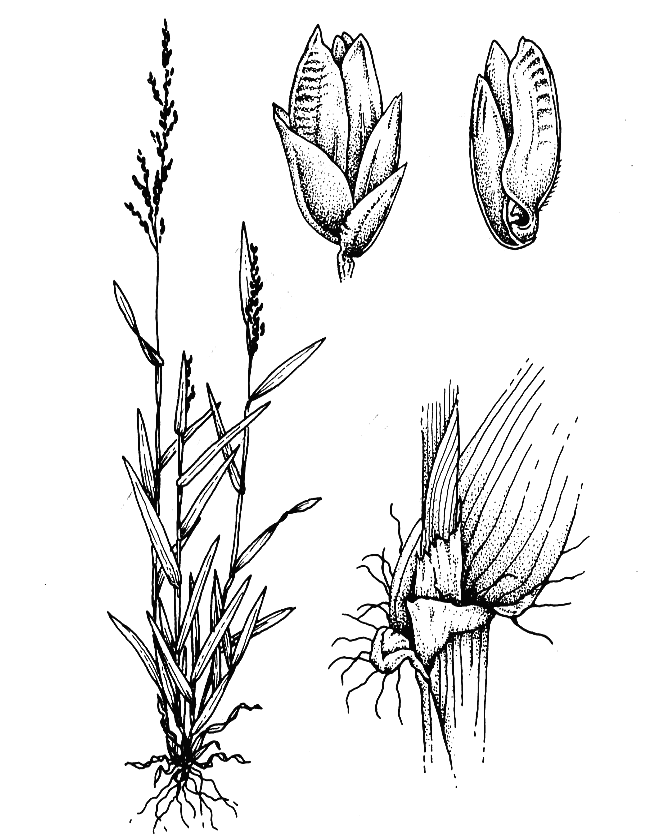
spike bentgrass, Agrostis exarata, June-August, Native

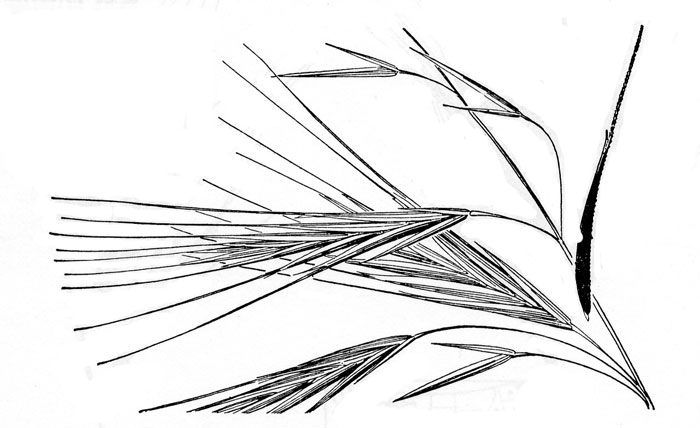
Occasional in mesic areas such as Trail "a" near its intersection with Trail 1, Trail 2, and Mapache Trail, about 100 yards south of its intersection with Trail 10, near arroyo willow and sneezeweed (Helenium puberulum). Plants have a more or less dense inflorescence and awned lemmas; perennial without rhizomes or stolons. Illustration left from Manual of the Grasses of the United States, 2 ed. PDF: http://standish.stanford.edu/bin/object?00003911


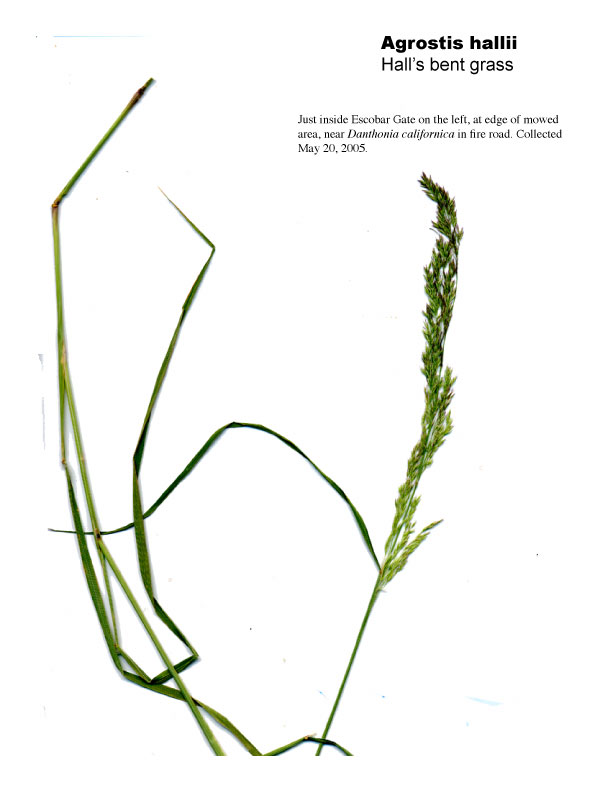
Hall's bent grass, Agrostis hallii, June-July, native

The question of Agrostis hallii or A. pallens (the latter including A. diegoensis)

These rhizomatous, leafy grasses are usually easy to pick out in their in their vegetative states in appropriate habitat by their relatively long cauline leaf blades and short stem internodes. Determining species even when in bloom can be difficult because critical measurements of local material frequently overlap.

In The Jepson Manual 2 (adapted):
plants from rhizomes
4. Floret callus hairs 1.5–2 mm, gen > 1/2 lemma; ligule 4–7 mm ..... A. hallii (3)
4' Floret callus hairs gen minute, sparse, or 0; ligule gen < 3 mm .... A. pallens


rhizomes or stolons 0
31. Floret callus hairs 1.5–2 mm, gen slightly > 1/2 lemma; anthers >= 1.5 mm ..... A. hallii
31' Floret callus glabrous or hairs minute, << lemma; anthers gen < 1.5 mm .... A. pallens


Barbara Ertter writes in the Diablo Flora, 2nd ed (2002) about A. hallii:

The very similar A. pallens Trin. (= A. diegoensis Vasey) differs primarily in that the hairs at the base of the floret are lacking or nearly so, and florets and ligules are smaller in general. The placement of most specimens from the East Bay in A. hallii, including all those from Mt. Diablo, is based on previously existing identifications, even though they are not compatible with the key break given by Harvey (JepMan) (i.e., the hairs are mostly in the 0.5-1.5 mm range.) Harvey notes, however, that the geographic and ecological variation of A. pallens is in need of further study. (p. 348)

In the addenda (p. 404) a collection of A. pallens is cited (Ertter & Morosco 16433)


In the Marin Flora (Howell 1970), A. diegoensis is common and A. hallii uncommon, and Howell writes “this species [>A. diegoensis] and the preceeding [A. hallii] are nearly confluent and at times difficult to distinguish, although A. diegoensis is generally more delicate in foliage and inflorescence.” p. 82.

Howell’s leads:
h. spikelets 3.5-4.5 mm l.; lemma 3 mm. l; hairs at base of lemma more than
1 mm long .... A. hallii

hh. spikelets 2.5-3.5 mm l; lemma 2-2.5 mm l; hairs at base of lemma 1 mm
or less .... A. diegoensis

J. Thomas' leads in his Flora of the Santa Cruz Mountains:

spikelets 3.5-4.5 mm l; lemmas about 3 mm l; the hairs at the base 1 mm l or
longer; . . . hallii
spikelets usu less than 3.5 mm l; lemmas 2-2.5 mm l; the hairs less than 1
mm l; . . . diegoensis

A. hallii panicle illustration from Manual of the Grasses of the United States, 2 ed. PDF: http://standish.stanford.edu/bin/object?00003911

A. diegoensis panicle illustration from Manual of the Grasses of the United States, 2 ed. PDF: http://standish.stanford.edu/bin/object?00003911

CalPhotos images of Agrostis hallii herbarium vouchers by Steve Matson.
CalPhotos images of Agrostis pallens herbarium vouchers by Steve Matson.


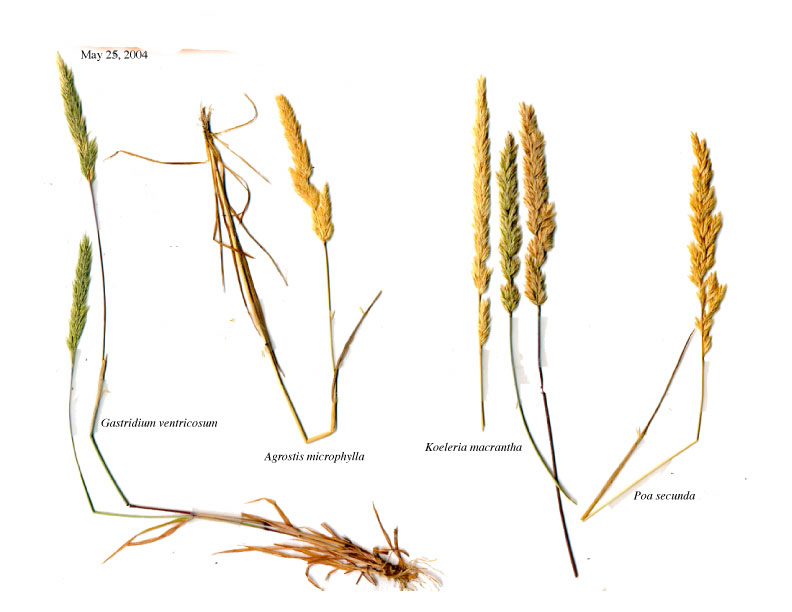
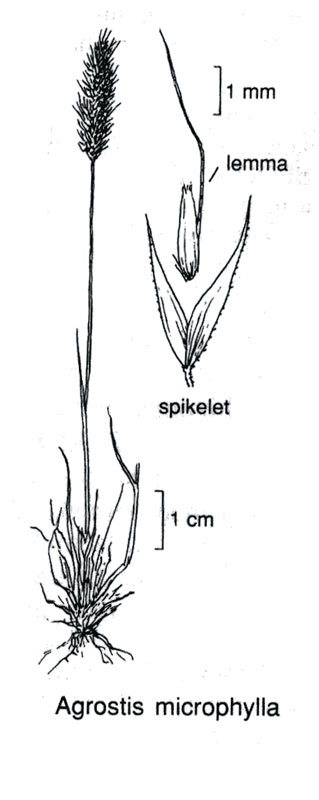
small-leaved bent grass, Agrostis microphylla, May–June, Native

One of four native annuals on our tour, occasional in serpentine, along the coast, and wet places where water has stood in spring. Walk out Trail 9 to the serpentine/chert contact where it grows with meadow barley, as well Road F just north of its intersection with Trail 9, on areas of especially thin serpentine soil, with other native annuals Vulpia microstachys and Deschampsia danthonioides. Look for the short grass with a dense, cylindrical flower head of single-flowered spikelets.
Illustration from Jepson Manual.
CalPhotos images of Agrostis microphylla herbarium vouchers by Steve Matson.

Name: Greek for pasture | small-leaved

leafy bent grass, Agrostis pallens, June-August, Native

Brush-covered areas and along the margins of chaparral. CalPhotos images of Agrostis pallens by Steve Matson.

Agrostis hallii and A. pallens: These two rhizhomatous, leafy grasses in their vegetative states are usually easy to pick out in the appropriate habitat by their relatively long cauline leaf blades and short stem internodes. Determining species even when in bloom can be difficulty because critical measurements overlap. See Agrostis hallii entry.

A. diegoensis panicle illustration from Manual of the Grasses of the United States, 2 ed. PDF: http://standish.stanford.edu/bin/object?00003911

CalPhotos images of Agrostis pallens herbarium vouchers by Steve Matson.

Wild oat

wild oat, Avena fatua, February–June, Europe
slender wild oat, Avena barbata, February-June, Europe

Among the most abundant and widespread grasses that make California’s hills “golden,” wild oat (A. fatua) and slender wild oat (A. barbata) cover lowland California west of the Sierra and southern deserts. While not found in adobe bricks of some of the state’s oldest buildings, wild oat probably arrived soon after the time of European settlement of California in 1769. See the posting "Replacement of the Native Vegetation."

Cluster and Allard (1995) write:
Historical records indicate that Avena barbata was introduced to California from Spain (Robbins 1940) . The first introductions probably occurred during the Spanish-Mexican colonial period (1769-1846), but Avena barbata did not become a major component of the flora in all areas with Mediterranean-like climates until cereal agriculture spread throughout California in the mid-19th century.
Minnich (2008) considers Avena barbata a member of the late-19th century suite of invaders including farmers foxtail, ripgut brome and red brome. Though present earlier he argues that these second wave exotics began dominating California valley and foothill grasslands 1890-1920s, citing numerous cintemporaneous sources (Minnich, p. 186).

Burcham (1957) writes:
Accounts of travelers contain records of the widespread distribution of some of the most important introduced plants at a comparatively early period. Traversing a portion of the central San Joaquin Valley in 1833, Zenas Leonard remarked, "This day our course lay through a large prairie covered with wild oats—which at this season of the year when nothing but the stock remains, has much the appearance of common oats" (Leonard, 1934). There is a possibility that a person unfamiliar with the vegetation of California crossing this region in November when only stalks of the grasses remained—and this was the situation with Leonard—may have confused wild oats with needlegrass; but this possibility is hardly plausible in view of his later experience in the State. Leonard also described large areas covered with wild oats in the valley north of Mission San Juan Bautista and elsewhere in the Coast Ranges. During his visit to California in 1841, Wilkes (1845) noted about San Pablo Bay and the Carquinez Straits that "the hills are thickly covered with wild oats"; the country about San Francisco presented a rather singular appearance, he said, due to the color of wild oats when ripened. Bryant (1848) refers to the occurrence of wild oats many times in the account of his travels in California in 1846 and 1847; crossing the bottomlands of the Mokelumne River, along its lower reaches, he remarked: "We passed through large tracts of wild oats during the day; the stalks are generally from three to five feet in length." Bryant described the Santa Clara Valley between San Jose and San Francisco as "a flat plain . . . covered with a great variety of grasses, wild oats, and mustard. So rank is the growth of mustard in many places, that it is with difficulty that a horse can penetrate through it." In 1851 the party of Col. Eedick M'Kee found wild oats growing abundantly on the foothills from Santa Rosa northward into the Russian River Valley; they were not noted north of the divide between Russian and Eel Rivers by that party (Gibbs, 1860).

It is probable that Russian settlers at Fort Ross were first to introduce wild oats and mustard, and other plants, north of San Francisco Bay. During the period of their occupation of Fort Ross, Russian writers noted that mustard grew wild in many places, requiring no cultivation; in various years from 100 to 200 pounds of seed was gathered and sent to Sitka (Khlebnikof, 1835). "In 1833 wild oats made its appearance in many fields in such abundance as to smother the wheat and the only means to suppress it was to pasture cattle on the fields for several years ..." (Tikhmenef, 1861-63). Obviously seed of mustard and wild oats—as well as other alien plants—were introduced as impurities in crop plants, many of which had been obtained directly from the Spaniards (Essig, 1933). Infestations of the magnitude reported by these writers would indicate introductions within a short time after founding of the colony.
Avena fatua and A. barbata awns are attached on the back of its lemmas; with a hand lens observe that the awn is a continuation of the midnerve (vascular bundle), and that the lemma is nerveless above. The awn is an adaptation that assists seed dispersal. Purple needlegrass also has a conspicuous, self-drilling, moisture-driven, hygroscopic awn, as does the ubiquitous forb storksbill, whose drill is actually its long, sharply-pointed persistent style column attached to the ripe fruit.

Cultivated oat (A. sativa) is an occasional escape from birdseed, but doesn't persist. California wild oatgrass is a species of the genus Danthonia.

Name: Latin for oat | simple.

BURCHAM, LT. 1957. California Range Land: An Historico-Ecological Study of the Range Resource of California. Davis [Calif.]: University of California, 1957.
CLUSTER, PD; ALLARD, RW. Evolution of Ribosomal DNA (rDNA) Genetic Structure in Colonial Californian Populations of Avena barbata. " Genetics 139: 941-54.

MINNICH, RA. 2008. California's Fading Wildflowers: Lost Legacy and Biological Invasions. UC Press.


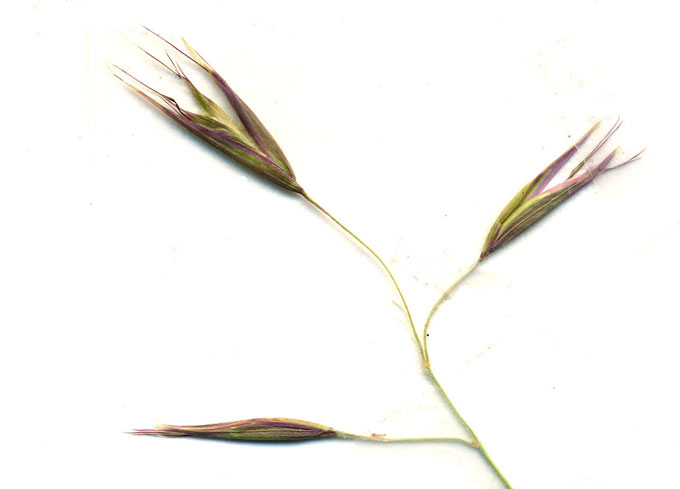
Illustrations of lemma tips of slender wild oat (attenuate to 4 mm l awns); and wild oat (short teeth), far left


purple false brome, Brachypodium distachyon, April-June, Europe

Widespread including serpentine, puple false brome, like Lolium, did particulary well in the long cool spring of 2006. Recognize it by the side-to-side compressed, overlapping spikelets, flat side toward the stem, spike-like inflorescence, and white stem nodes. It makes a strong showing just below the Field Station access road and toward the lake, near the goldenaster (Heterotheca sessiliflora ssp. echioides) site.

Purple false brome was first noted at JRBP in 1977. It is not included in John Thomas (1961) Flora of the Santa Cruz Mountains of California.

rattlesnake grass, Briza maxima
little quaking grass, Briza minor

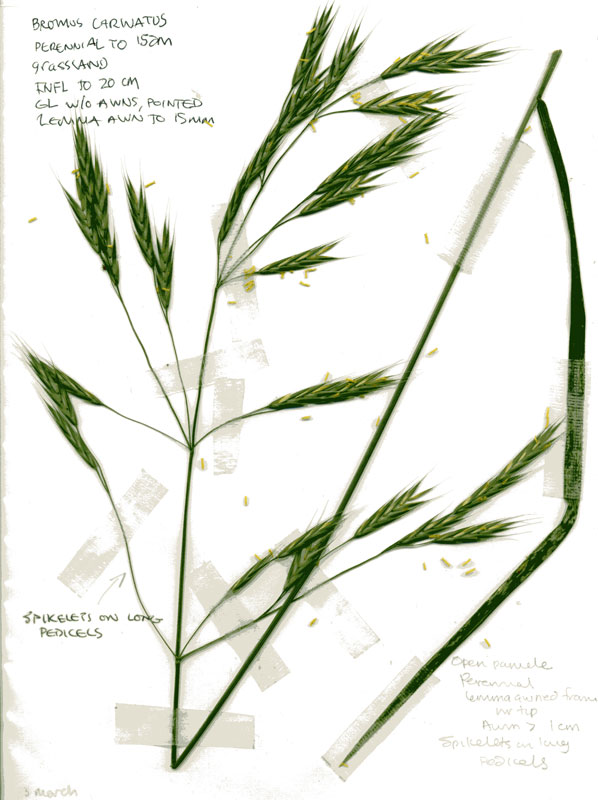
California brome, Bromus carinatus var. carinatus, April–Oct, Native

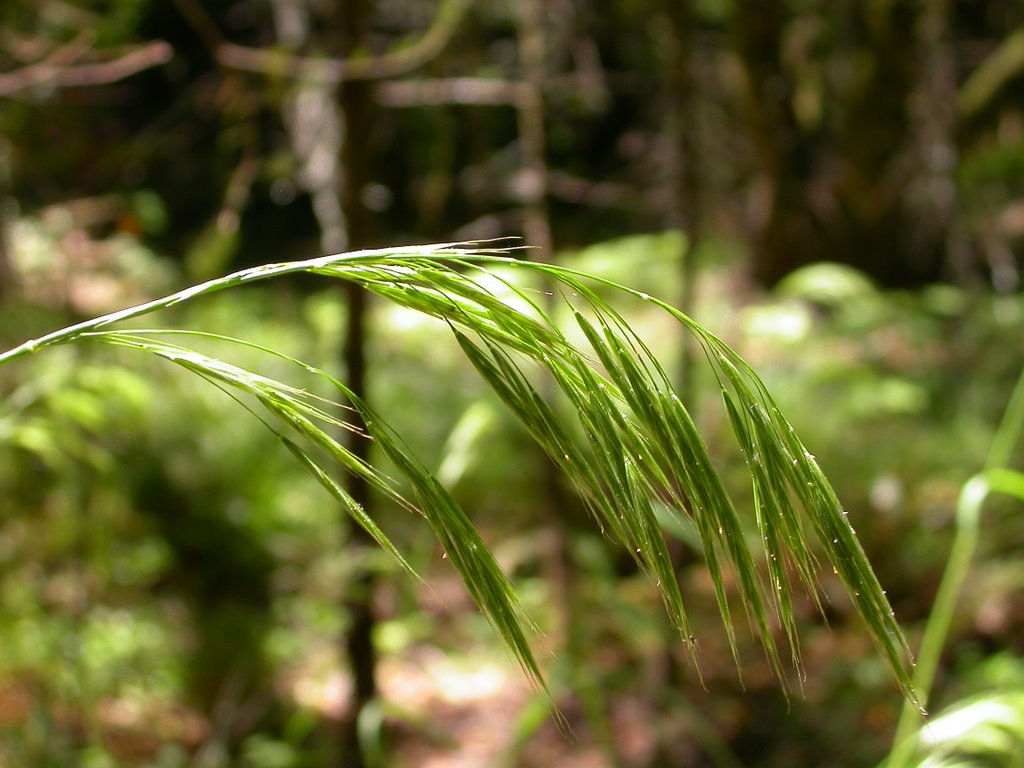
California brome is a short-lived perennial, moderately tall to about 3 feet or more, and nodding. Side-to-side compressed florets open up (chevron pattern in illustration) as flowering progresses, a common grass transformation.

Frequently in partial shade, it also grows in full sun and in serpentine. Its leaves are slightly gray-green, mostly flat, and largely die-back in the summer. Leaf sheaths are either smooth or visibly soft-hairy. Florets disarticulate above the glumes, which are often seen on the old, standing culms.

Another tall perennial brome with strongly-keeled lemmas, B. catharticus, is a common campus weed has been found on the Preserve at the Dennis Martin site. It is distinguishable at arms-length by its very short awns (less than 3 mm) and smooth, dark-green stems. Another ruderal brome, B. stamineus, has been collected near the old lake bathhouse and the caretakers yard. It also has an open inflorescence, but unlike California brome and rescue brome, its branches are stiffly ascending. With a hand lens its broad (1 mm wide) transluscent lemma wings are apparent. It is said to accept summer water, remain green, and avoid summer dormancy.

Two varieties are recognized by FNA. Both have been vouchered for Jasper Ridge; var. marginatus is uncommon.

1. Most awns 8–17 mm long................................. var. carinatus

1. Most awns 4–7 mm long............................... var. marginatus

Name: ancient Gk name | keeled.

ripgut grass, Bromus diandrus, April–July, Europe

Suprisingly, given their morphological differences, the annual ripgut can be mistaken at a distance for purple needle grass (Nassella pulchra). Take a second look. At a closer distance poverty brome might appear as depauperate ripgut.

Name: ancient Gk name | two-stamen.

Illustration from Leroy Abrams, Illustrated Flora of the Pacific States, Stanford University Press, 1923.

woodland brome, Bromus laevipes, May–August, Native
narrow-flowered brome grass, B. vulgaris, May-July

Bromus laevipes has normally somewhat shorter flowering branches than California brome, borne on stems with shorter internodes, woodland brome (and its dried stalk too) has a crosier-like inflorescence, and usually offers a handshake. The lemma backs are rounded rather than keeled, and can be densely hairy--or not. Young spikelets are more or less cylindrical. Mature spikelets, however, are clearly laterally compressed. Woodland brome grows on serpentine and is widespread on the Preserve, usually in partial shade. It flowers later than California brome.

A form of woodland brome with glumes and lemmas evenly puberulent, mentioned in the Jepson Manual, has been called Bromus pseudolaevipes and is vouchered in the JRBP herbarium.

B. vulgaris looks very much like woodland brome but is typically taller with wider leaves and larger diameter stems, and grows in and around redwood groves on trails 1 and 2, where it is common.

Photographs of Bromus laevipes by Craig Cummings, June 26, 2006.

Name: ancient Gk name | polished.
poverty brome, Bromus sterilis, April-June, Europe

Poverty brome can be confused for a small form of ripgut. Distinguising characteristics include the very long inflorescence branches relative to spikelet length, usually with one spikelet per branch. The spikelets are smaller than those of ripgut, the grass overall finer, and branches and spikelets less scabrous. The awn length can overlap the shortest range of ripgut lemma awns. At Jasper Ridge it is found in partial shade, is seldom dominant, and seldom is found in open grassland, where ripgut can dominate.


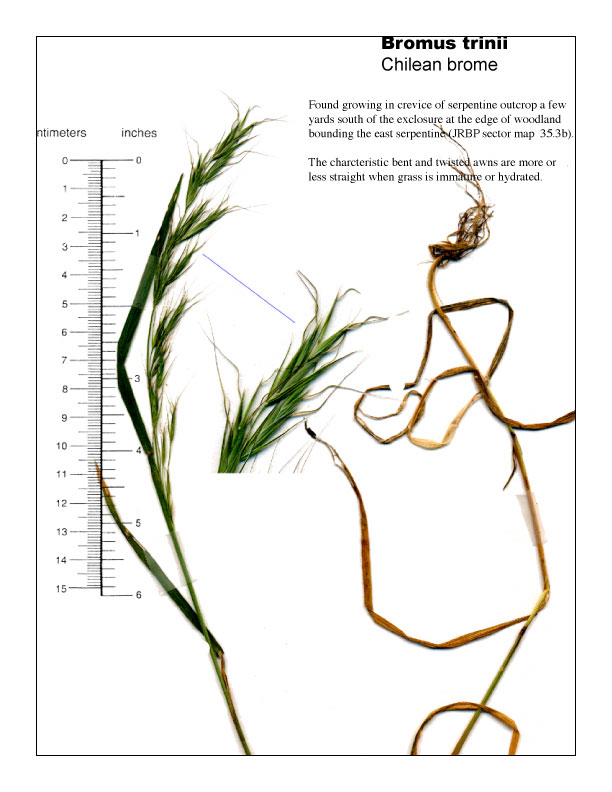
Chilean brome, Bromus trinii
(B. berteroanus in FNA, v.24:223-224)
Known from a serpentine outcrop in area H adjacent to the abandoned exclosure, until a second station was found March 4, 2007, several plants in bloom just a few yards east of the extensive Allium falcifolium area UTM 0568637, 4140177; Sector 24, upper 4B. In April 2010 it was found along trail 15 and also Rd F in serpentine. This pilose annual plant has a long awn (13+ mm) arising from the sinus of acuminate lemma teeth and the first glume has a single vein. Lemma backs are more or less rounded. The characteristic awn bend and twists is apparent in dried specimens.


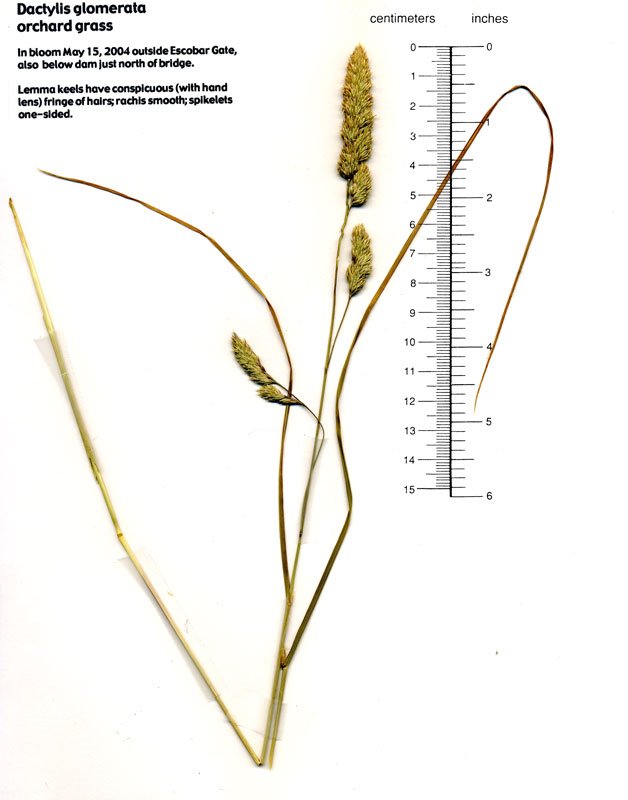
orchard grass, Dactylis glomerata, May-Aug
California oatgrass, Danthonia californica, May–July, Native

California oatgrass is often cryptic, being low growing with flowering stalks that are typically horizontal near the ground, as if knocked down by a high wind. It forms some the most extensive stands of native grasses on the Preserve, including south of Trail 3 on either side of Rd. F, and in low-lying mesic areas north and south of Global Change site. At the latter site, which includes the vernal pond which provides habitat for California semaphore grass, California oatgrass forms conspicuous tussocks. It has self-fertile (cleistogamous) florets in lower stems stacked upon one another above the stem nodes.

Unlike most other native California grasses mentioned in this blog, which belong to the Pooideae subfamily comprised of mostly Northern Hemisphere, temperate region grasses, Danthonia belongs to the Arundineae Tribe of the Arundinoideae subfamily of Poaceae (subfamily Danthonioideae in the recent Flora of North America's treatment), and has a characteristic field character of that group, namely, ligules of hairs rather than a membrane. Other Arundinoid grasses seen locally include the serious wildland invasives giant reed and Pampas grass. Danthonia, with its long glumes and lemmas awned from the middle of the back, earlier was placed in the Avena Tribe. [The higher level classification of Danthonia has changed again in the Flora of North America.]

Name: for E. Danthoine of France | from California.

slender hairgrass Deschampsia elongata, May-June

This delicate grass with a basal tuft of fine leaves might be confused with young Nassella lepida but seldom share the same habitat. Slender hairgrass is occasional in mesic areas such as trails 1, 2, 5, and 13, and abundant along the slope and in the swale on the west side of road D south of trail 6. On trail 5 look for it at the plank-buttressed section of trail below the old gate, growing with Collomia heterophylla, both blooming in May.

annual hairgrass, Deschampsia danthonioides, May–June, Native

Look for its delicate, open panicle at the Trail 9 serpentine/chert contact, growing with meadow barley, small-leaved bent grass, and common hairyleaf fescue, and on Road F in small barren places north of the Trail 9 intersection with hairy fescue and hairyleaf fescue. It can be abundant on Road F at the well-known docent stop for the diminutive, fragrant Pogogyne serpylloides, where it is universally overlooked.

Name: J. L-Deslongchamps, France | danthonia-like.

Illustration, Manual of the Grasses of the United States, 2 ed. PDF: http://standish.stanford.edu/bin/object?00003911
CalPhotos images of Deschampsia danthonioides.
ehrharta, Ehrharta erecta, naturalized

Ehrharta erecta has only recently been noticed on the Preserve. In early December, 2005, at Bear Creek and Sand Hill Rd fence, the herbarium crew collected ten or more ehrharta, fruiting. Appearing at first blush like an onion-grass, the small-flowered melic Melica imperfecta, it was dispensing its fertile florets far and wide among the tall cyperus and California blackberry. It can now be found along San Francisquito Creek in the Preserve, and is well-established around the Indian grinding rock at the beginning of Trail A.
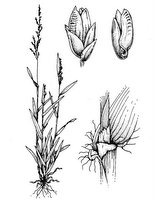
Native to the Western Cape, it is one of a formidable South African contingent including Cape ivy, and yellow oxalis (Bermuda buttercup) that are colonizing, inexorably, significant portions of coastal California. (Bossard 2000; Sigg 2003). It is a challenge to walk anywhere in San Francisco or Berkeley and not find ehrharta. It was not listed in the 1958 A Flora of San Francisco, (The Wasmann Journal of Biology 16: 1-157) nor in John Thomas (1961) Flora of the Santa Cruz Mountains of California: a Manual of the Vascular Plants. It has colonized Stanford's prime garden areas including the Inner Quad circles, and can be found in the California Native Garden. Ehrharta propagates by seed and exhibits both upright and trailing growth habits. It is a member of a small old world grass tribe of perennials and annuals that has been classed differently by authorities into higher taxa/subfamilies (Gould 1983), and is currently classified in subfamily Ehrhartoideae, which also includes the California native Leersia oryzoides.

A.S. Hitchcock And A. Chase wrote of ehrharta in the 1950 Manual of Grasses of the United States:

Escaped, Berkeley, CA (evidently from the campus of the University of California). Shows considerable competitive ability and may become of value in replacing some of the troublesome weeds.

Philip Munz noted in his 1959 A California Flora, "Naturalized on the Berkeley campus. . . Introduced from South Africa." Sigg (2003) says that it was collected by G. Ledyard Stebbins as "adventive [introduced but not yet naturalized] in Botanical Garden, UCLA Campus, Los Angeles, in May 1946," and asks whether this collection was the source of Stebbin's research material? Stebbins, an eminent plant geneticist and founding member of the California Native Plant Society, had earlier written that ehrharta "became established as an adventive in northern California about 1930." (Stebbins 1985). Dr. Stebbins wrote in The ladyslipper and I (p. 83) that before he experimented with ehrharta that it was "already spontaneous in a small corner of the Berkeley campus".

Dr. Stebbins introduced ehrharta into test plots in the San Francisco Bay region in 1943 as part of an experiment:

. . . 22 different plantings were made of diploid and autotetraploid [created by Stebbins in his lab] Ehrharta, some of which consisted of seed sown in 5 x 5 m plots . . . while others were started by planting well-rooted clonal divisions . . . Sixteen of the plots were on the campus of the University of California, Berkeley, and two each in the inner Coast Ranges of Napa County, the campus of the University of California at Santa Cruz, and the town of Carmel. (Stebbins 1985).

He noted in the 1985 article "Polyploidy, Hybridization, and the Invasion of New Habitats" that the unaltered specimens were reseeding in most of the plots, and had spread extensively into surrounding areas. Of a Strawberry Canyon plot:

For several years . . . little change was noticed, but about 1965 ehrharta spread extensively westward. The plants colonized relatively diverse areas, some of them in hard-packed soil and others in well-drained areas under redwoods.

Dr. Stebbins wrote about the experiment in his memoir:

Of the 10 sites in which I had planted seeds, only three gave results after the first generation, and in only one of them was the autopolyploid at first superior to the diploid planted next to it. Between the 10th and 15th generation , even this superiority disappeared, and in 1970, 26 years the original planting, the diploid spread first over a few meters and later over 100 meters beyong the original planting while the autotetraploid was almost completely confined to the original area. The superiority of the diploid over the auto tetraploid increased until 1984, 40 years after the original planting.

Time will tell how persistent and extensive ehrharta will become at Jasper Ridge.

image source: California Invasive Plant Council: Invasive Plant Inventory

References (* = in JRBP library)

Bossard, Carla. 2000. Invasive Plants of California's Wildlands.* http://groups.ucanr.org/ceppc/Invasive_Plants_of_California's_Wildlands/
Gould, Frank and Robert Shaw. 1983. Grass Systematics. 2nd ed.*
Hitchcock, A.S. 1950. Manual of Grasses of the United States.*
Jepson Online Interchange. http://ucjeps.berkeley.edu/interchange.html
Munz, Philip. 1959. A California Flora.*
Sigg, Jacob. 2003. "Triple Threat from South Africa." Fremontia 31(4):21-28.
Stebbins, G.L. 2007. Ladyslipper and I. Missouri Botanical Garden.
Stebbins, G.L. 1985. "Polyploidy, Hybridization, and the Invasion of New Habitats." Ann. Missouri Bot. Gard. 72:824-82. In JSTOR from Stanford IP addresses: http://links.jstor.org/sici?sici=0026-6493%281985%2972%3A4%3C824%3APHATIO%3E2.0.CO%3B2-5


blue wildrye, Elymus glaucus, April–June, Native

Blue wildrye grows aggressively in full sun and canopy openings and in dry to moist soil, and is one of the most common grasses of the West. It grows in grassland, chaparral, woodland, and forest, and is associated on the Preserve with Bromus carinatus. Its grains (seeds) were collected for food; burned grass seeds are conspicuous food remains recovered at local Indian sites.

A short-lived bunchgrass, it can also spread by short stolons, vegetative reproduction being a notable feature of many grasses. The eminent grass specialist Agnes Chase writes, “This ability to make new shoots and cover large areas . . . is an adaptation that allows grasses to dominate open habitats, coexist with grazing animals, and survive fires.” Rhizomes and stolons are specialized stem branches that form at basal stem nodes and grow horizontally. Stem growth resulting in bunch grasses primarily grows up inside the sheath and emerges at its apex.

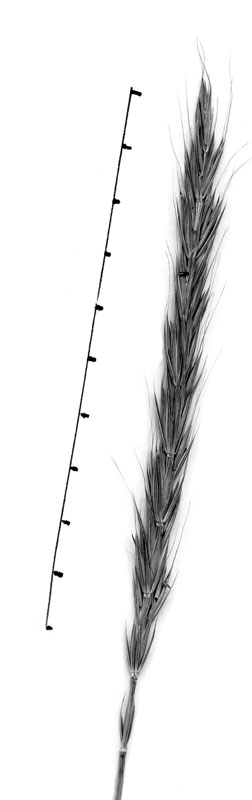
The inflorescence is a true spike, its individual spikelets, usually in groups of 2, directly attached to nodes of the flowering stalks without pedicels (sessile). Infl. 6 to 16 cm long, not breaking apart with age (look for the old flower stalks); lemma awns 1-3 cm. long. Leaves flat, upper leaf often flag-like (folded at 90ยบ angle to stalk).

Subspecies virescens which has shorter lemma awns, < 5 mm long, has also been reported, but not vouchered, for the Preserve. This grass quite possibly has a sporadic distribution on serpentine but has been overlooked in the field.

Name: ancient Gk name for millet | with a whitish coating.
Elymus glaucus x E. multisetus, squirreltail hybrid, May-August (Elymus hanseni; Sitanion hanseni)

There are several example on and off serpentine. The plants most easy to view is growing just off Trail 9, about 100 yards from Road E, on the north side of Trail b about 50 yards from Road F, and at the beginning of Trail 8 near its intersection with Road D. Elymus glaucus and E. multisetus grow nearby in both locations. This grass was shown by G. L. Stebbins to be a F1 sterile hybrid between Elymus glaucus and, in this case, E. multisetus.